

How a saved seat moves two scores
You know this kid. Yesterday, when someone saved them a seat, they mumbled, “You didn't have to.” Today they're at lunch ten minutes early, fending off all comers with a backpack. Would it kill them to say thank you? Probably. Would they let anyone take that chair? Absolutely not.
That's the setup for the first Quick scene. If you pick “Very like me,” the favor earns points for Tsundere, the archetype with a soft spot to cover. The little shrug costs points on Deredere, where the affection tends to come right out into the open. There's enough room in one lunch period for both observations.
You can make the card beside this story yourself. Pick 5 for the saved seat, then 3 for all eleven scenes that follow. You'll get 83% Tsundere and 42% Deredere. Give the first scene a 3 as well, and both land on 50%. Let's stick with the backpack kid and see where those two wonderfully specific numbers came from.
- R
- Points your choices have added or taken away
- C
- Most points those scenes could add on this axis
The card shows whole percentages. A half point rounds up.
- Tsundere83%
- Deredere42%
What a 5 actually does
The center button, 3, means “In between.” Count outward from there. A 4 puts you one step toward the scene, a 5 puts you two steps toward it, and a 1 puts you two steps away. Now look at the weight the quiz assigns the gesture. The saved seat gets a +2 for Tsundere. Agree as strongly as you can and you've just added four points to that axis. The same answer times Deredere's −1 takes two points off its running total.
Next lunch, your favorite person sits with somebody else. You happily finish the conversation at your own table. Suddenly “Very like me” does something quite different. Easy company counts toward Kuudere's composure. Being fine with the change pulls the Yandere reading inward. Here's the arithmetic for both lunches if you give each one a 5.
| The moment | Axis weight | Points toward the score |
|---|---|---|
| You repay the favor tomorrowD01 · Tsundere | +2 | 2 × (+2) = +4This scene contributes 4 to capacity. |
| You play it down todayD01 · Deredere | −1 | 2 × (−1) = −2This scene contributes 2 to capacity. |
| Your favorite person eats elsewhereD02 · Yandere | −2 | 2 × (−2) = −4This scene contributes 4 to capacity. |
| You enjoy the company at your tableD02 · Kuudere | +1 | 2 × (+1) = +2This scene contributes 2 to capacity. |
How much should four points be worth? That depends on how many points the scenes you've answered could possibly give that axis. Call that room its capacity, or C. Each answered scene adds twice the size of its weight, ignoring the sign, even if you choose 3. The other letter on the formula card, R, is the running total you actually earned. It gets to keep its minus signs.
Right after the first 5, Tsundere has earned all four points available so far, so the live chart reads 100%. Deredere sits at 0%. Kuudere hasn't had a turn. Open the axis table and you'll see “No answers yet” beside that name. This is the moment to resist writing the season finale. Eleven lunches, awkward introductions, and other small encounters still get a say.
Back in our original example, eleven middle answers give Tsundere more room without adding any more points. R is still 4 and C is now 6. Multiply 50 by (1 + 4/6) and round once for 83%. Deredere gets its own calculation, 50 times (1 − 2/12), rounding to 42%. Nobody has to give back 25 points to make the bill total 100. Each spoke has a whole scale to itself.
Two cards worth opening side by side
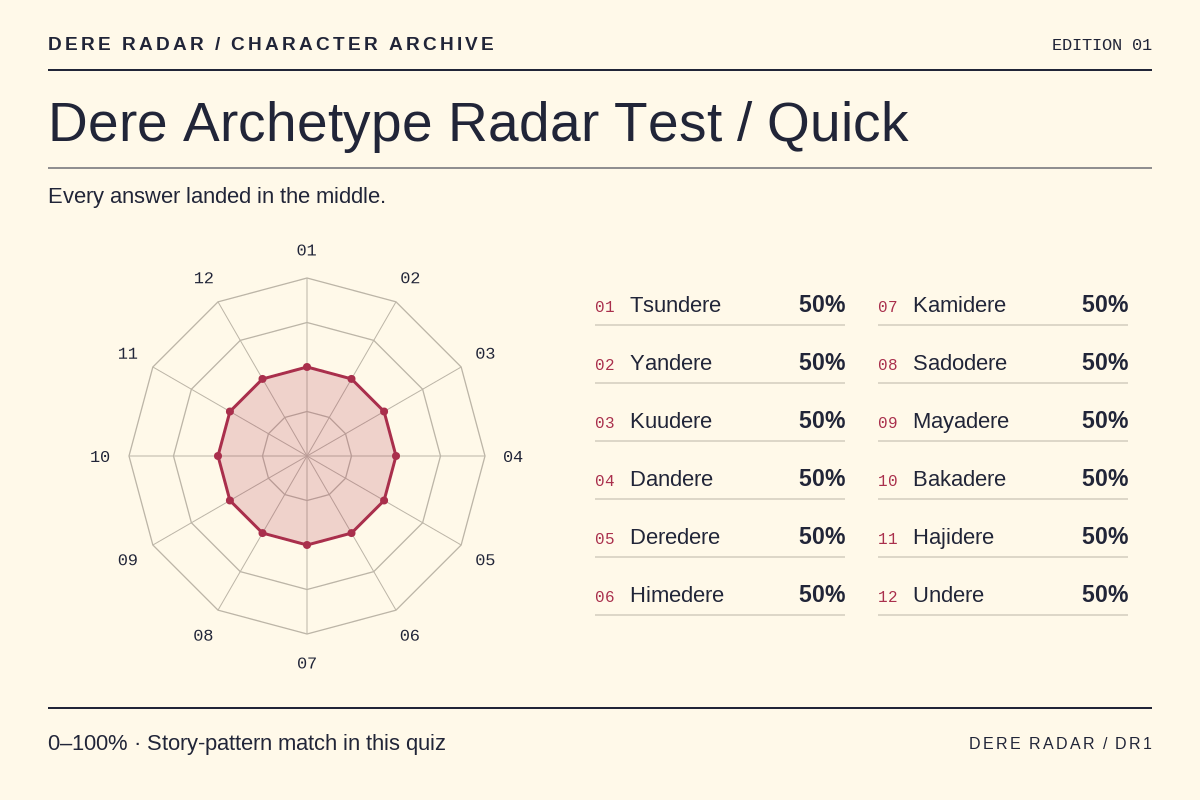
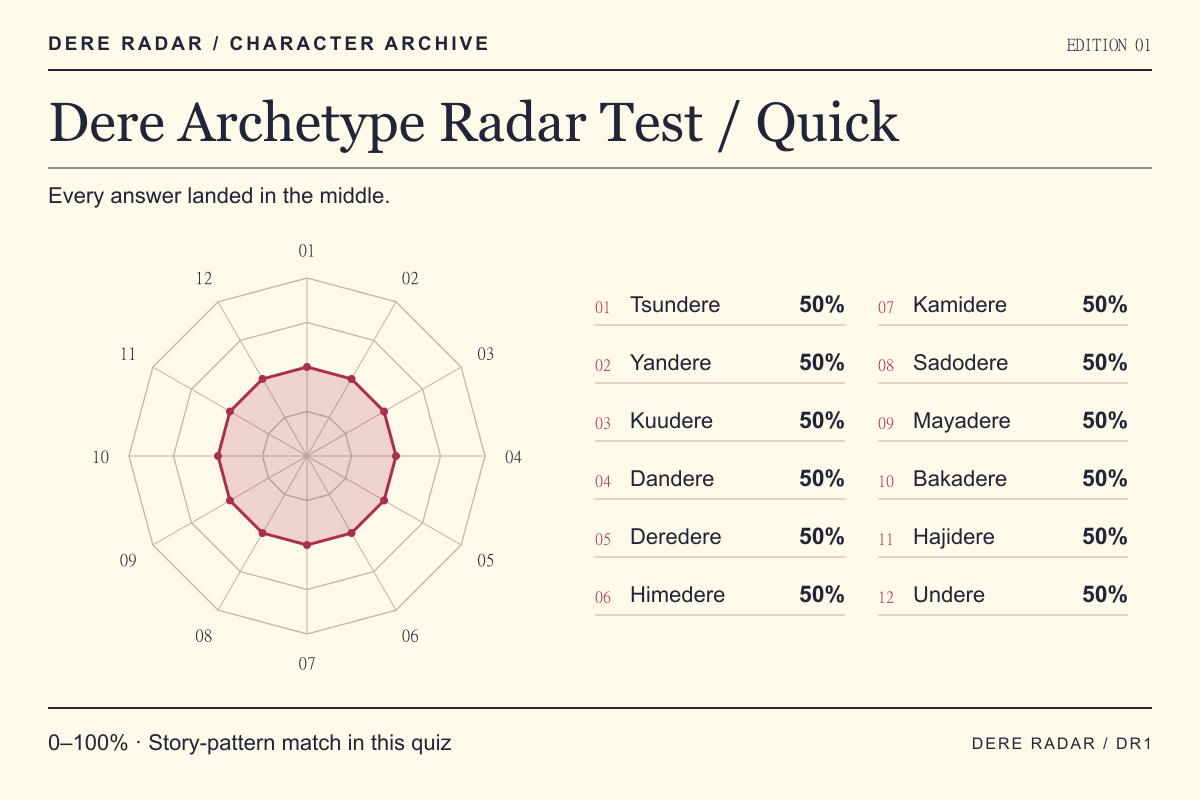
Start with the midpoint sample. Every reply is 3. Run your eye around that tidy ring and you've found the halfway mark on every spoke. A stranger with wildly different replies could also land near 50% on an axis if some scenes pulled it out and others drew it back. One number can't tell you which route they took.
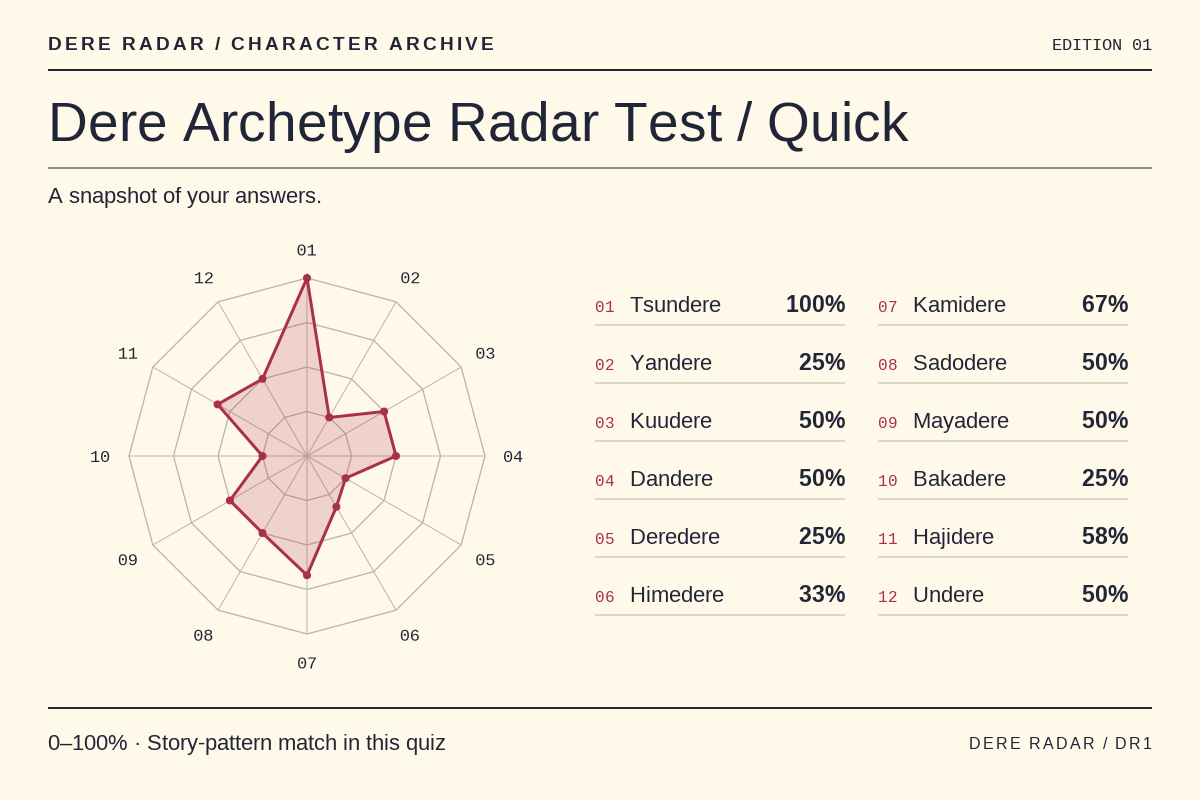
Now open Prickly Helper. Someone here will fix the crooked wheel on your cart, get grease up to the elbow, and claim the squeak was getting on their nerves. That's one way to play a 100% Tsundere lead. Kamidere comes next at 67%. Give the helper a second line about exactly whose idea it was to buy this ridiculous cart, and you can hear that confidence in their own judgment alongside the affection.
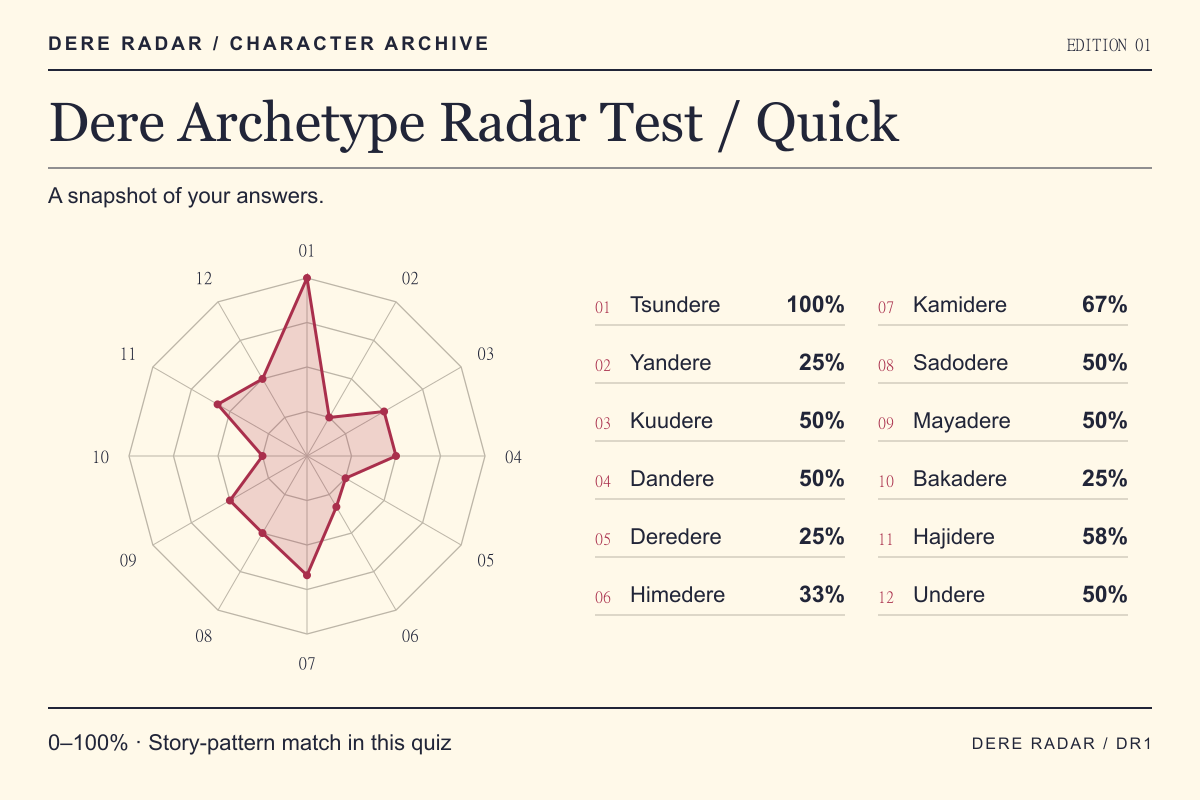
Who gets the close-up in a tie?
Quiet Observer has two regulars in the starring role. Kuudere and Dandere both reach 100%. Picture the same kid holding steady through a noisy club meeting, then waiting until the walk to the station to tell one friend the joke they've had in their pocket all afternoon. Which part would you cut? The quiz keeps both. On a mixed run with different scores in a panel, every axis at the highest rounded percentage shares the lead. Every axis at the next distinct percentage shares second billing.
Sometimes everyone in a panel gets the exact same number, so the card displays every percentage without assigning a winner or runner-up. The same goes for a run where you press one answer all the way through, even when the weights give the chart a lopsided shape. On the dual radar, each seven-axis panel gets its own ranking. Envy could lead the impulses and Kindness the virtues. Try writing the few seconds between hearing who got the solo and offering them a ride to rehearsal.
Quick or Full for your dere type test?
Quick gives twelve archetypes twelve scenes to make an impression. Full opens with those same scenes, then adds twenty-four more. If the sarcastic seat-saver seems awfully familiar, wait until somebody spots the playlist they made. Full gives them a chance to own up to choosing every single track. A longer run gives that kid more lines. You'll still have a separate Quick draft to go back to.
The specialist forms change the question. Yandere spends twelve scenes on four facets of a bond. Tsundere vs. Kuudere spends twelve on two ways of showing care. Sins and virtues has twenty-eight scenes for two panels of seven traits apiece. If a Tsundere percentage changes when you switch forms, look at the scenes each form put in front of you. A pair of cards makes more sense when you can read the form name at the top of each.
Following an archetype by its ink
Maybe the first thing you remember about a result is the little badge next to a name. Here are the twelve together, with a written cue for each. The badges turn up again in the field guide. If two swatches look like the same shade on your phone, the name underneath will get you back to the right entry.
 TsundereGuarded warmth
 YandereAttachment intensity
 KuudereComposed affection
 DandereQuiet entry into a group
 DeredereOpen affection
 HimedereEnjoyment of special treatment
 KamidereConfidence in one's own direction
 SadoderePlayful challenge between willing partners
 MayadereChanging allegiance as trust develops
 BakadereGood-humored, unguarded mistakes
 HajidereFluster around affection
 UndereAccommodation of a favorite person
The flowers in the margins
See that camellia on the cover? Open the full print and you can follow its branch past the flower that made the crop, down through the leaves and out into the bare paper. It's the same pleasure as finally seeing the whole background painting behind an episode title. Feel free to linger. The ink on this plate doesn't enter the arithmetic.

Fifteen takes you can check
Here are the repeat performances we use to check the scorer. Some have personalities you could cast tomorrow. Others have the thankless role of showing up with one answer missing. Pick a row that resembles your run and read across. The last column tells you what this particular set of choices produces, down to the cases where the scorer has to stop.
| The run | Behind the choices | What comes out |
|---|---|---|
| Quiet observerQuick · case 01 | The whole table hears the compliment. The good conversation happens later, on the walk home. | Kuudere, Dandere share the lead at 100%. |
| Prickly helperQuick · case 02 | Already did the favor. Would dearly love it if everybody quit making a thing of it. | Tsundere leads at 100%. |
| Open heartedFull · case 03 | First to welcome the new kid, first to cheer a friend, quick on the draw with a thank-you. | Deredere leads at 98%. |
| All midpointQuick · case 04 | Twelve trips down the middle of the scale. Every scene gets a 3. | A neat ring at 50% all the way around. Nobody takes the lead. |
| All highFull · case 05 | All thirty-six scenes sound very familiar, including the ones whose weights pull inward. | The weights still give you individual percentages. Repeating the exact same button on every scene skips the winner and runner-up badges. |
| All lowQuick · case 06 | A 1 for every Quick scene. Disagreeing about how easily you settle in at lunch pushes one spoke out. | The weights still give you individual percentages. Repeating the exact same button on every scene skips the winner and runner-up badges. |
| Yandere mixedYandere · case 07 | One kind message can turn the whole day around. Time apart still has a place. | Emotional intensity leads at 86%. |
| Tsundere contrastTsundere vs. Kuudere · case 08 | The favor goes fine. Getting thanked for it in front of everybody is the hard part. | Tsundere leads at 95%. |
| Dual radarSins and virtues · case 09 | Quick to share the good stuff and keep a chosen limit. Also quick to snap at an interruption. | Wrath leads at 70%. Generosity, Chastity, Temperance share the lead at 85%. |
| Shared leadQuick · case 10 | Twelve choices, two archetypes at the same peak, a third close behind with a spot of its own. | Yandere, Sadodere share the lead at 100%. |
| Missing lastQuick · case 11 | The eleventh scene is done. Someone closed the tab before answering the twelfth. | One scene to go. Resume the draft and answer it to see the finished card. |
| Out of rangeSins and virtues · case 12 | The last answer arrives as a 6, a choice you could never make on the worksheet. | Scoring stops here. Every choice has to be a whole number from 1 to 5. |
| String answerTsundere vs. Kuudere · case 13 | A test file supplies the last 4 as a piece of text instead of a number. | Scoring stops here. Every choice has to be a whole number from 1 to 5. |
| Alternating extremesQuick · case 14 | Left endpoint, right endpoint, repeat. Six pairs of opposites make a complete Quick run. | Dandere, Kamidere, Sadodere, Bakadere, Hajidere share the lead at 100%. |
| Equal two stylesTsundere vs. Kuudere · case 15 | The replies change from scene to scene. By the credits, the two style bars are exactly level. | Both styles land at 52%. An even tie skips the winner badge. |
Cases six and fourteen make a good double feature. In the first, someone holds down the low end for the whole run. In the second, they bounce between the two extremes. Both charts have points at the outer edge. Only the second has varied answers and distinct score bands to rank. Case fifteen takes a third route. Different answers get the two styles to the same 52%, and this time the panel stays level.
Give one answer a second take
Try the saved-seat experiment from the other side of the lunch table. On your own completed run, choose Review answers, change that first reply, then use See my result. The later choices are still there. If you're halfway through a run, Back takes you to the preceding scene. With local storage available, you can close the worksheet and come back to the same form in the same browser profile.
Found a reading you want to keep before trying another? Save the card now. Washi Editorial and Midnight Otaku give the same figures a different wardrobe. A PNG is handy for the group chat, and the SVG stays sharp if you'd like to zoom in. The privacy guide to sharing a result shows exactly what a friend can read and where your original answers live.
Written by Dere Radar · Scoring version dr1 ·
Questions from the other side of the chart
I came for a “what dere am I” quiz. Which page gets me there?
Meet all twelve dere archetypes on the homepage. Quick is enough to see which names turn up in the same scene. If a late reply is the part you keep replaying, try the yandere spectrum. For the eternal mystery of who stayed late to carry your amp and why they look so annoyed about it, try Tsundere vs. Kuudere.
Can a character hold a grudge and still do the decent thing?
Sure. Suppose your rival gets the solo. You may need a full minute alone with that news before you find the spare sheet music and slip it into their bag. The 7 deadly sins and 7 heavenly virtues test gives each side its own set of percentages. You can follow that first sting and the generous next move on the same card.